Victorinox Fibrox Pro Chef Knife Review: 6 Years Later

Affiliate disclosure: Some links on this page are affiliate links. If you buy through them we earn a small commission at no extra cost to you. Recommendations are research-driven; we don't claim personal use of every product reviewed. Product prices and availability are accurate as of the date published and are subject to change. Always check Amazon for current pricing before purchasing. Learn more.
Best-performing knife under $50 , used in professional kitchens worldwide
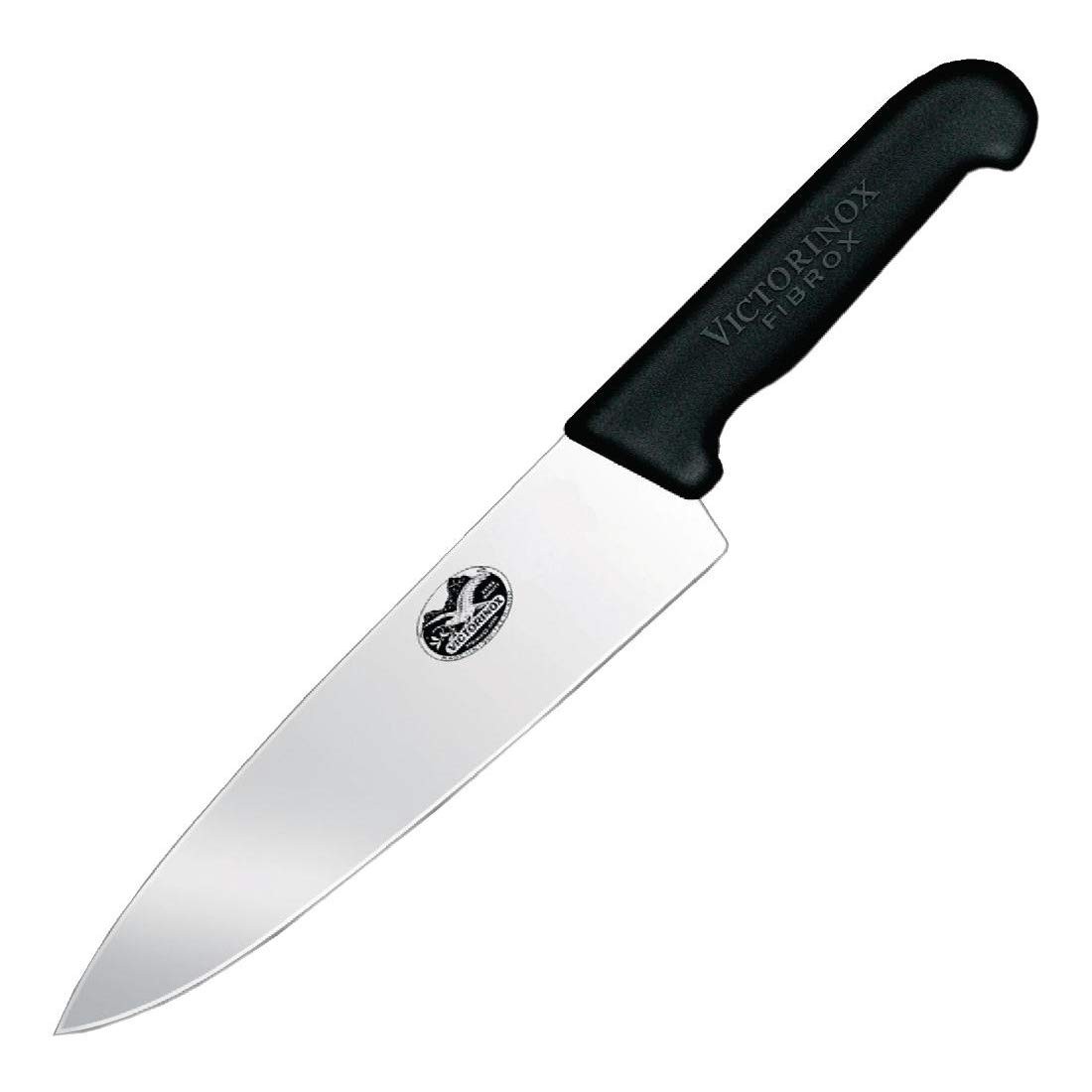
See Victorinox Fibrox Pro 8-Inch Chef's K… on AmazonThere’s a version of this conversation where I tell you the Victorinox Fibrox Pro 8-Inch Chef’s Knife is “good for the price” and leave it at that. That version is less useful to you. The more accurate statement is this: the Fibrox Pro is the knife I recommend to people who ask me what they actually need, as opposed to what the cookware industry would prefer they buy. This knife has been in this kitchen for six years. It has cut more onions, broken down more chickens, and done more rough vegetable prep than I care to count. The blade is stamped, the handle is utilitarian plastic, and it costs a fraction of what you’d pay for a German forged knife. It is also sharp, reliable, and honest in a way that a lot of expensive knives are not.
If you’re doing research on chef’s knives more broadly, the Knives & Sharpeners hub is a reasonable place to start before narrowing down.
The Knife
The Fibrox Pro is a stamped blade. That distinction matters and I’ll address it directly: forged knives are cut from a single billet of steel, which gives them a bolster, a bit more heft, and generally a steel that holds an edge longer between sharpenings. Stamped knives are cut from a flat sheet of steel, which makes them thinner, lighter, and less expensive to produce. Neither method is inherently better. They’re different tradeoffs.
Victorinox uses high-carbon stainless steel at a Rockwell hardness in the mid-50s, which is softer than the Japanese steels you’ll find on something like the Mac Professional Series Chef’s Knife but comparable to most German forged production knives. The edge comes out of the box at about 15 degrees per side, which is a reasonable working angle. It’s sharp without being so acute that minor mishandling will roll it.
The blade is 8 inches. Spine thickness is modest. The taper toward the tip is gradual enough to give you a real point for detail work, though this is not a precision knife in the same category as a Japanese blade. It’s a workhorse.
Check the Victorinox Fibrox Pro 8-Inch Chef’s Knife on Amazon
The handle deserves a few sentences because it’s the thing people either accept or don’t. The Fibrox handle is molded thermoplastic elastomer, textured, black, and designed for grip in wet conditions. It won’t slip when your hands are wet, which is a real consideration if you do volume prep. What it is not is beautiful. There’s no weight, no craft, no sense that anyone gave aesthetic thought to your hand. If you want a knife that looks good on a magnetic strip in a photo, this is not that knife. If you want a knife that you pick up and use without thinking about it, this is exactly that knife.
Weight is approximately 5.5 ounces for the 8-inch version. Compared to a forged 8-inch from Wüsthof or Zwilling, that’s noticeably lighter. Whether that’s an advantage depends on your technique. Pinch-grip cooks who do most of their work with wrist and arm motion often prefer a lighter blade. Cooks who rely on the weight of the knife to assist the cut may find the Fibrox feels insubstantial.
Performance
I want to be specific here because “sharp” and “performs well” are not useful descriptions.
Out of the box, the Fibrox Pro cuts cleanly through paper. Push-cutting onions, it sails through without tearing. Rock-chopping parsley takes no extra force. On the first use, it performs at a level that most knives costing three or four times as much would match but not clearly exceed.
Where the gap eventually shows up is edge retention. The stamped steel is softer than forged steel in the same class, and you will notice it dulling faster if you’re doing significant volume. My honest estimate after years of cooking: the Fibrox needs honing about twice as often as my old Wüsthof Classic 8-inch, and I take it to a whetstone or pull-through sharpener a bit sooner than I would a forged blade. This is not a disqualifying complaint. It means you need to maintain it. Most people who complain their knives are dull own expensive knives they never sharpen.
The narrow blade profile means it’s less efficient at scooping and transferring chopped food from board to pan, compared to a knife with more blade height. (I realize that’s a specific complaint, but it’s the one I actually notice.) If you do high-volume prep where you’re constantly shuttling food with the flat of the blade, you may reach for something with more surface area.
For most tasks, the Fibrox is simply good. Butternut squash, where you need a combination of sharpness and control, fine. Julienning carrots, where the blade needs to maintain a consistent plane through the cut, fine. Breaking down a chicken, where the tip needs to follow a joint accurately, fine. The knife does not telegraph weakness in any of the ways that actually matter during cooking.
One note on care: Victorinox lists the Fibrox Pro as dishwasher safe, which is technically true and practically a bad idea. The high heat and harsh detergent will dull the edge faster and fatigue the handle material over time. Hand-wash it. This applies to every knife you own, regardless of what the manufacturer claims.
Given the price point, checking current Amazon availability for the Victorinox Fibrox Pro 8-Inch Chef’s Knife before you decide is worth the minute — this is one of the few knives where the list price is close to what you’ll actually pay.
Victorinox Fibrox Pro vs. Wüsthof Classic
The Wüsthof Classic 8-Inch Chef’s Knife is the most direct comparison because it’s what most people upgrading from a cheap knife are looking at alongside the Fibrox. Wüsthof’s pricing puts it in the premium category. The Fibrox Pro is budget. The gap between them in list price is significant, often approaching four or five times the cost of the Victorinox.
What does that premium buy you? Forged X50CrMoV15 steel with a Rockwell hardness in the upper 50s, better edge retention between sharpenings, a full bolster that adds balance and protects the heel of your hand, and a handle that feels like it was designed by people who thought about the object as a whole. The Wüsthof is noticeably heavier and that weight contributes to a rocking motion feel that some cooks find easier. It also holds its edge meaningfully longer.
What it does not buy you is a cutting experience that is categorically different from a well-maintained Fibrox. I cooked with a Wüsthof Classic for eight years before switching to the Victorinox as my daily driver. The Wüsthof is objectively a more refined object. But the difference in actual food preparation is smaller than the difference in price implies.
If you’re comparing at the high end, the Zwilling J.A. Henckels Chef Knife is another forged German option worth considering alongside Wüsthof. It splits the difference on some handling characteristics, though the fundamental forged-vs-stamped tradeoff remains the same.
The Fibrox’s case is not that it’s as good as a Wüsthof in every dimension. It isn’t. The case is that the dimensions where it falls short are mostly addressable through more frequent maintenance, and the gap in cooking performance for most home cooks doesn’t justify the price difference. If you’re buying your first real chef’s knife and you’re not certain how much knife technique matters to you yet, buying a Fibrox and spending the difference on a decent whetstone is the better allocation of money.
Who Should Buy This Knife
The Fibrox Pro is the right knife for a specific kind of cook. If you want to understand how it fits alongside other options in its class, the full guide to Knives & Sharpeners has context on what separates budget, mid-range, and premium picks.
Buy the Fibrox if you are starting from scratch and want to know what a sharp knife actually feels like before committing to something more expensive. Buy it if you have a kitchen where knives disappear, get used carelessly by others, or end up in places they shouldn’t be. Buy it if you run a vacation rental, an office kitchen, or any setting where you need a competent knife that won’t hurt when it vanishes or gets ruined.
Buy it if you’re equipping a second kitchen or a camping setup where weight matters.
For any of those use cases, the Victorinox Fibrox Pro 8-Inch Chef’s Knife is straightforward to order and shows up ready to use — no break-in period, no initial sharpening required.
Consider something else if edge retention is your primary concern and you don’t want to think about maintenance. If you have the technique and the budget, a forged German knife like the Wüsthof Classic or a mid-range Japanese option like the Mac Professional Series Chef’s Knife will reward you with longer-lasting sharpness and a more satisfying tool to handle. And if you find yourself working in a range of sizes, we’ve also looked at what a well-designed 5 inch Santoku knife can handle for lighter prep tasks where an 8-inch chef’s knife is more than you need.
The honest verdict: this knife performs well above its price category. It will not be the knife you show people. It will be the knife you reach for.
Check the Victorinox Fibrox Pro 8-Inch Chef’s Knife on Amazon before buying. Budget pricing can shift, but this knife has stayed in the same general range for years.
Frequently Asked Questions
Is the Victorinox Fibrox Pro a good knife for beginners?
Yes, and specifically because it removes the excuse not to cook well. A beginner with a sharp Fibrox Pro will cut better than a beginner with an expensive knife they’re afraid to use or maintain. Start with a tool that performs reliably and doesn’t carry financial anxiety. The Fibrox Pro qualifies on both counts.
How often does the Victorinox Fibrox Pro need sharpening?
Under regular home cooking use, plan to hone it before each use with a honing steel, and sharpen it on a stone or with a pull-through sharpener every two to three months. That’s more frequent than a forged German knife of equivalent quality, but the maintenance process itself takes five minutes. If you skip honing and only sharpen when the knife stops cutting, you’ll need to sharpen it more often. The schedule I described assumes reasonable upkeep.
Can the Victorinox Fibrox Pro go in the dishwasher?
Victorinox says yes. My answer is no. Dishwasher detergent is abrasive, and the high heat accelerates edge degradation and handle wear. This applies to all knives, not just the Fibrox Pro. Wash it by hand, dry it immediately, and put it on a magnetic strip or in a block. Takes thirty seconds.
How does the Fibrox Pro compare to the Victorinox Fibrox 8-Inch Chef’s Knife?
The Fibrox Pro (model B000638D32) replaced the original Fibrox line. The blade geometry is slightly revised, the handle ergonomics were refined, and the NSF certification for commercial use was maintained. If you see the older Fibrox listed at a steep discount, the difference between them is marginal. The Pro version is the current standard and the one I’d buy new.
Is a stamped blade chef’s knife worth buying over a forged one?
For most home cooks, yes. The practical difference in cooking performance is smaller than the marketing around forged knives suggests. Forged knives hold their edge longer, have better balance characteristics, and are generally more refined objects. Stamped knives are lighter, require more frequent maintenance, and cost significantly less. If you sharpen your knives regularly, the stamped blade disadvantage largely disappears in daily cooking. The Victorinox Fibrox Pro is the strongest argument for that position.
Victorinox Fibrox Pro 8-Inch Chef's Knife: Pros & Cons
- Best-performing knife under $50 , used in professional kitchens worldwide
- Lightweight stamped blade with a sharp edge out of the box
- Stamped steel loses its edge faster than forged alternatives
Frequently Asked Questions
Is the Victorinox Fibrox Pro a good chef's knife for the price?
Yes — the Fibrox Pro is the most consistently recommended budget chef's knife in professional circles and home kitchens alike. Out of the box it cuts cleanly through paper, handles everything from onions to chicken breakdown, and costs a fraction of comparable German forged knives. The tradeoff is edge retention: the stamped steel dulls faster than forged blades and requires more frequent honing.
How does the Victorinox Fibrox Pro compare to a Wüsthof Classic chef's knife?
The Wüsthof Classic uses forged X50CrMoV15 steel at higher Rockwell hardness, holds its edge longer between sharpenings, has a full bolster for balance and hand protection, and weighs noticeably more. The Fibrox Pro is lighter, less expensive by a factor of four or five, and performs at a level that most home cooks cannot meaningfully distinguish from the Wüsthof on a typical Tuesday night.
Is the Victorinox Fibrox Pro dishwasher safe?
Victorinox lists it as dishwasher safe, but running any quality knife through a dishwasher is a bad practice. High heat and harsh detergent accelerate edge dulling and fatigue the handle material over time. Hand-wash and dry immediately for the best long-term performance.
How often does the Victorinox Fibrox Pro need to be sharpened?
The stamped steel dulls faster than forged alternatives — expect to hone it about twice as often as a German forged knife, and take it to a whetstone or pull-through sharpener somewhat sooner. This is manageable and not a disqualifying flaw, but it does mean the knife rewards cooks who maintain their tools regularly.
Is the Victorinox Fibrox Pro good for professional kitchen use?
Yes — the Fibrox Pro is genuinely used in professional kitchens worldwide, particularly in high-volume prep environments where knives are honed frequently and sharpened on rotation. Its lightweight feel and washable handle make it practical for sustained use. It's not the knife you'd choose for a fine dining kitchen where blade aesthetics matter, but for pure function it performs.
Where to Buy
Victorinox Fibrox Pro 8-Inch Chef's KnifeSee Victorinox Fibrox Pro 8-Inch Chef's K… on Amazon