All Clad vs Tramontina: Is the Price Difference Worth It?

Affiliate disclosure: Some links on this page are affiliate links. If you buy through them we earn a small commission at no extra cost to you. Recommendations are research-driven; we don't claim personal use of every product reviewed. Product prices and availability are accurate as of the date published and are subject to change. Always check Amazon for current pricing before purchasing. Learn more.

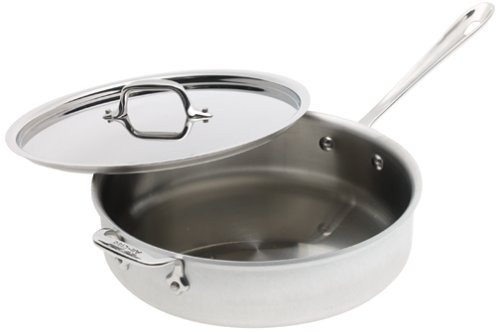 All-Clad All-Clad D3 Stainless 12-Inch Fry Pan Buy on Amazon
 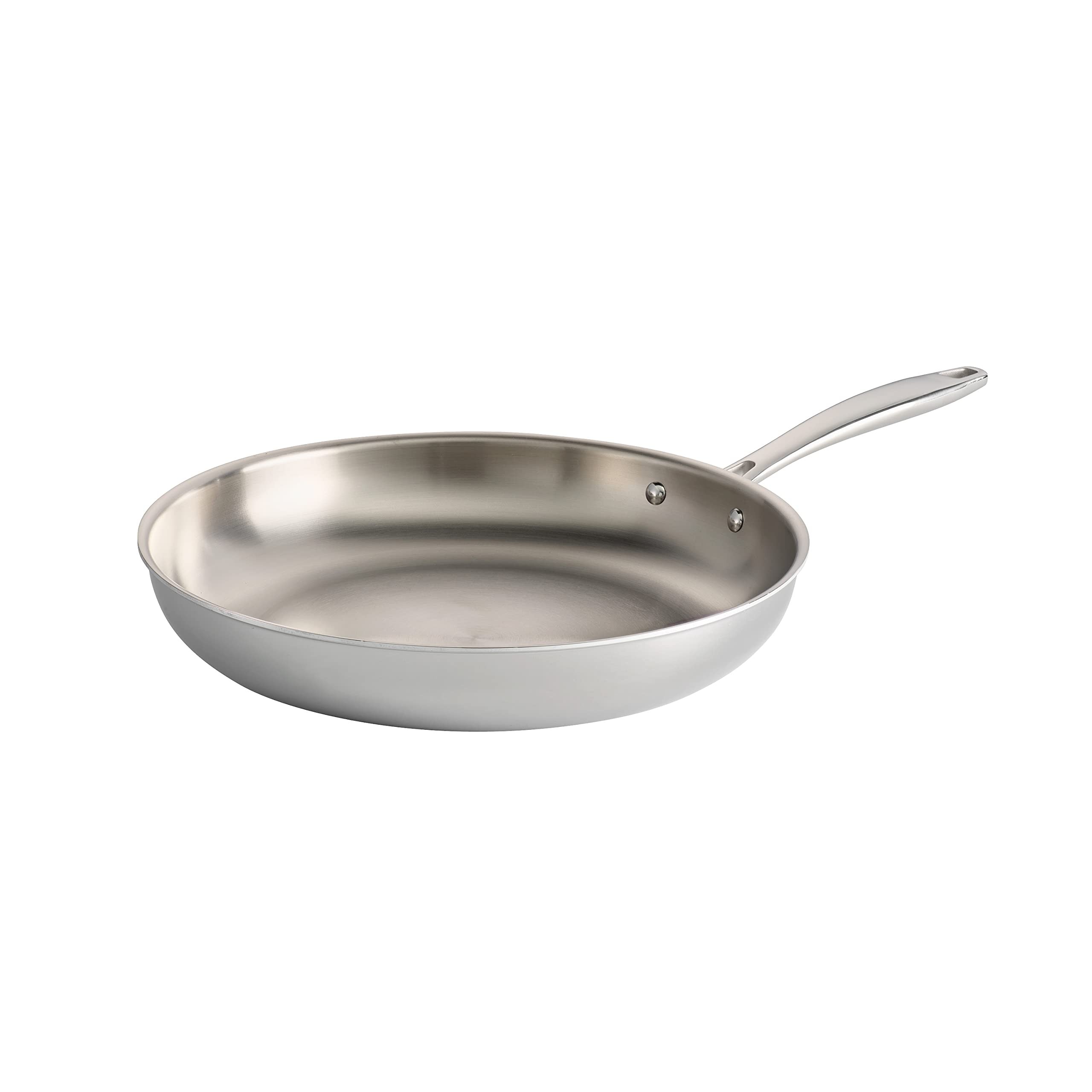 Tramontina Tramontina 12-Inch Tri-Ply Clad Stainless Fry Pan Buy on Amazon
 If you’ve spent any time in the Stainless & Clad section of this site, you already know the basic argument: bonded tri-ply construction, stainless interior, aluminum core, stainless exterior. Two pans side by side use exactly that construction. One costs roughly three times the other. So the question is whether that price gap reflects a real difference in how the pan performs, or whether you’re paying for American manufacturing and a brand name that’s been on professional ranges since 1971.
I’ve cooked with both. My verdict is more qualified than “just buy the cheap one,” but also more qualified than “All-Clad is always worth it.” The answer depends on what you’re actually cooking, how often, and whether handle feel over a decade matters to you.
The Two Pans
The All-Clad D3 Stainless 12-Inch Fry Pan is the American tri-ply benchmark. Made in Canonsburg, Pennsylvania, it’s the pan that most imported alternatives are explicitly designed to undercut. Premium pricing, lifetime warranty, oven-safe to 600°F, induction compatible. It has been manufactured to the same basic specification for decades, which is either a sign of confidence in the design or a lack of imagination, depending on your perspective.
The Tramontina 12-Inch Tri-Ply Clad Stainless Fry Pan is made in Brazil, uses genuine tri-ply construction with the same bonding method, runs mid-range pricing, and is oven-safe to 500°F. Professional cooks have recommended it as a budget-conscious alternative for years. The question is whether “alternative” means “equivalent” or “close enough.”
Both are 12-inch fry pans. Both have stainless cooking surfaces. Neither is nonstick, which means both require technique. If you’re looking for something more forgiving on the learning curve, the All-Clad Non Stick Sauce Pan is a different conversation entirely.
Construction
The Cladding
Tri-ply means three bonded layers: 18/10 stainless on the cooking surface, an aluminum core, and magnetic stainless on the exterior for induction compatibility. Both pans use this method. The bonding process, when done correctly, means the aluminum core extends fully up the sidewalls, not just across the base. Disk-bottomed pans bond only at the base. Both of these are fully clad. That matters for anything you’re cooking up the sides of the pan.
Where they diverge is gauge. All-Clad’s D3 construction uses a slightly thicker aluminum core than the Tramontina. The difference is measurable with calipers and perceptible in use: the All-Clad retains heat marginally longer after you pull it from the burner and recovers faster after adding cold protein. If you’ve ever seared a cold chicken breast and watched the pan temperature crash immediately, the core thickness is part of what you’re paying to fix.
The Tramontina’s thinner gauge isn’t a defect. It’s a manufacturing tradeoff that makes the price point possible. Under most home cooking conditions, including searing, sautéing, and pan sauces, the difference is minor. Under sustained high-volume cooking or repeated back-to-back sears, it becomes more apparent.
Handles and Fit
All-Clad’s handle is a riveted stainless steel stick handle with a slight upward curve and a hollow underside that keeps it cooler over the stovetop. It’s been refined over decades. After extended cooking sessions, the ergonomics hold up. The rivets are flush, which makes cleaning straightforward.
The Tramontina handle is functional but less refined. It’s heavier relative to the pan size, and the angle of attachment puts slightly more wrist torque on a full pan. Not a dealbreaker for most cooking, but if you’re making a large frittata you’re finishing in the oven and then carrying to the table, you’ll notice the difference. (I did notice. More than once.)
The All-Clad also includes a helper handle, which the Tramontina does not. On a 12-inch pan fully loaded, a helper handle is not decorative.
Performance
Heat Distribution
Both pans passed a butter-melt test evenly across the cooking surface at medium heat on my gas range. The All-Clad held a marginally tighter hot-spot-free zone, but I want to be precise about what “marginally” means here: this is a difference you’d detect with a thermal camera, not a difference that will show up as an unevenly browned egg.
For everyday sautéing and pan sauce work, the Tramontina distributes heat well enough that most cooks would not identify a problem. The All-Clad’s advantage shows more clearly at high heat and under heavy loads.
Searing
Searing is where the All-Clad’s thicker core earns some of its premium. I seared four bone-in chicken thighs back-to-back in each pan at the same starting temperature. The All-Clad maintained a higher surface temperature between additions. The Tramontina recovered, but more slowly, which affected crust development on the second and third additions. This is the kind of cooking where the construction difference becomes actual output, not theoretical.
For a single sear, a steak or a fish fillet, the Tramontina performs comparably. The gap widens when the pan is working harder.
Stainless Cooking Surface
Neither pan is beginner-friendly on this point. Stainless requires preheating, fat, and patience. If you’re not letting the pan fully preheat before adding oil, food will stick to either one. The All-Clad’s reputation for sticking is not a flaw in the pan. It’s a user error that gets attributed to the product. Same applies to the Tramontina.
The stainless interiors are visually indistinguishable, and both respond the same way to the cold oil test (drop of water beads and rolls freely, add oil, heat until shimmering, then add food).
Oven Use
The All-Clad is oven-safe to 600°F, which gives you full clearance for broiling. The Tramontina tops out at 500°F, which covers most oven applications, including finishing proteins and roasting vegetables, but excludes sustained broiler use. If you regularly use your skillet under a broiler, that 100-degree gap is a real constraint. If you don’t, it’s irrelevant.
For context on building out a coordinated cookware set, the All-Clad 2 Qt Saucepan and All-Clad 4 Quart Saucepan follow the same D3 construction, so the performance profile is consistent across pieces.
Value Case
When the Tramontina Makes Sense
If you’re equipping a first serious kitchen, replacing a warped nonstick pan, or buying cookware for a vacation home, the Tramontina makes a strong case. Genuine tri-ply construction at mid-range pricing is not a compromise pick. It’s a well-made pan that will perform correctly for years under regular use.
If you’re buying one skillet and a full set of other pans to complement it, spending three times more on the skillet alone may not be where your budget is best deployed. A Tramontina skillet with a quality Dutch oven and a well-made saucepan will serve you better than an All-Clad skillet alongside inferior everything else.
When All-Clad Is Worth the Premium
The All-Clad case is strongest if you cook at high volume, use the pan daily, cook large batches that stress heat retention, or care about buying once and keeping the same pan for twenty years. The lifetime warranty means something on a pan that will see daily use. The handle ergonomics, the extra oven clearance, and the thicker core become meaningful when the pan is working hard consistently.
This D3 skillet has been in daily rotation for eleven years. It looks and performs identically to when I bought it. That is the honest case for the premium. (Whether a pan that costs three times more should simply be expected to last three times longer is a fair counterargument, and I don’t have a strong response to it.)
The All-Clad D3 is also worth considering if you’re already building toward a full D3 set. The All-Clad 8 Quart Stock Pot and All-Clad Stock Pot 12 Quart share the same construction logic, and owning matched pieces simplifies how you think about heat behavior across your kitchen.
For buyers comparing this to other premium options, Made In’s 12-inch fry pan occupies similar pricing to the All-Clad and uses a five-ply construction. It’s a credible competitor, though its handle geometry is different enough that side-by-side testing is worth doing before committing.
Verdict
The Tramontina 12-Inch Tri-Ply Clad Stainless Fry Pan is a genuinely good pan. If the price difference is meaningful to you, buy it without apology. The construction is sound, the performance is competent, and the cooking you do in it will be indistinguishable from the All-Clad in most situations.
The All-Clad D3 Stainless 12-Inch Fry Pan earns its premium specifically in high-heat performance under load, handle quality over time, broiler clearance, and the confidence of a lifetime warranty on a pan you’re planning to use daily for the next decade. Those are real advantages. They’re just not advantages that justify three times the price for every cook or every kitchen.
This kitchen runs All-Clad at the skillet and sauté pan level because I use those pans every day and the construction difference shows up in my actual results. For pieces I use less frequently, I wouldn’t rule out the Tramontina. That’s the honest answer. Check current pricing on Amazon for both before deciding, since the gap between them fluctuates and occasionally the case becomes even clearer in one direction.
More context on building out a stainless set, including what to prioritize and what to skip, is available in the full Stainless & Clad guide.
Frequently Asked Questions
Is Tramontina tri-ply actually the same construction as All-Clad?
The bonding method is the same: three layers, fully clad up the sidewalls, with an aluminum core between stainless steel layers. The difference is in gauge. All-Clad uses a thicker aluminum core, which improves heat retention and recovery under heavy cooking loads. Same architecture, different specification.
Can I use the Tramontina skillet on an induction cooktop?
Yes. The Tramontina 12-inch tri-ply uses a magnetic stainless steel exterior and is fully induction compatible. So is the All-Clad D3. Neither pan requires any adaptor or modification for induction use.
Does All-Clad’s lifetime warranty cover normal cooking damage?
All-Clad’s lifetime warranty covers defects in material and craftsmanship under normal household use. It does not cover damage from misuse, such as overheating an empty pan, using metal utensils aggressively, or putting the pan through a dishwasher repeatedly against the manufacturer’s guidance. For everyday cooking damage from proper use, the warranty holds.
Why does food stick to my stainless steel pan?
Almost always, the pan was not preheated sufficiently before adding fat, or fat was added before the pan reached temperature. Stainless steel needs to be hot before food contacts it. Preheat the pan on medium heat until a drop of water beads and rolls across the surface, then add oil, heat until shimmering, and add food. This applies equally to All-Clad and Tramontina.
Should I buy the 10-inch or 12-inch version of either pan?
For a single-pan purchase intended to cover most cooking tasks, the 12-inch is the more versatile choice. A 12-inch handles a full pound of pasta protein, four chicken thighs, or a large frittata. The 10-inch is better as a second pan for eggs, smaller sautés, and one or two servings. If you’re buying one pan, buy the 12-inch.
Frequently Asked Questions
Is Tramontina actually as good as All-Clad for home cooking?
For most home cooking tasks — sautéing, pan sauces, searing proteins — the Tramontina tri-ply clad skillet performs comparably to the All-Clad D3. The difference shows up under sustained high-volume cooking: All-Clad's thicker aluminum core retains heat slightly longer after adding cold food and recovers faster, which matters more in a professional kitchen than a home one.
Where is Tramontina tri-ply cookware made?
Tramontina tri-ply clad cookware is manufactured in Brazil. All-Clad D3 is made in Canonsburg, Pennsylvania, USA. Both use genuinely bonded tri-ply construction with the same basic method — the difference is in gauge thickness and manufacturing precision, not construction category.
Does Tramontina have a lifetime warranty like All-Clad?
No. All-Clad offers a limited lifetime warranty on their stainless clad lines. Tramontina's warranty terms are more limited. If long-term warranty coverage is a factor in your decision, All-Clad holds a meaningful advantage.
Can Tramontina tri-ply handle induction cooking?
Yes. The Tramontina tri-ply skillet has a magnetic stainless steel exterior that works on induction, though it is rated oven-safe to 500°F rather than All-Clad's 600°F — a distinction that rarely affects home cooking but matters if you're finishing very high-heat applications in the oven.
Is the All-Clad helper handle worth the price difference over Tramontina?
For a 12-inch skillet loaded with a large frittata or a full braise, the helper handle on the All-Clad is a practical safety feature — one the Tramontina lacks. If you regularly cook large, heavy one-pan meals that go from stove to oven to table, the helper handle alone can justify part of the price premium.
Where to Buy
All-Clad D3 Stainless 12-Inch Fry PanSee All-Clad D3 Stainless 12-Inch Fry Pan on Amazon