Demeyere vs All-Clad: Premium Stainless Cookware Compared

Affiliate disclosure: Some links on this page are affiliate links. If you buy through them we earn a small commission at no extra cost to you. Recommendations are research-driven; we don't claim personal use of every product reviewed. Product prices and availability are accurate as of the date published and are subject to change. Always check Amazon for current pricing before purchasing. Learn more.

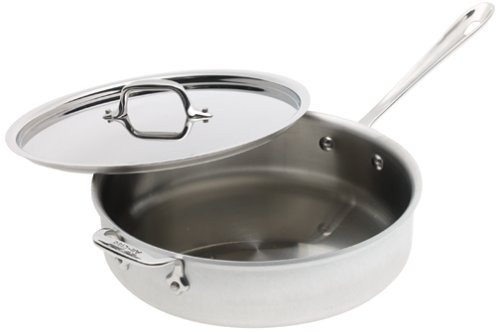 All-Clad All-Clad D3 Stainless 12-Inch Fry Pan Buy on Amazon
 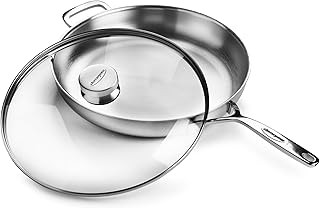 Demeyere Demeyere Industry 11-Inch Skillet Buy on Amazon
 If you’ve spent any time researching stainless cookware, you’ve probably landed on these two names. The All-Clad D3 Stainless 12-Inch Fry Pan is the default answer most serious cooks give when someone asks what stainless skillet to buy. The Demeyere Industry 11-Inch Skillet is what people switch to, or buy instead, when they want something built with a different philosophy. Both are premium products. Both carry lifetime warranties. Both require real money and real technique to use well. The question is which one earns that investment in your kitchen, not in general. Our full breakdown of this category lives in the Stainless & Clad guide if you want broader context, but this article is specifically about these two pans and which one wins.
My position: there is a clear answer, and it depends on one variable more than any other.
At-a-Glance
Both pans are built for serious cooking, priced at the top of the stainless category, and warrant the same basic care: heat the pan before adding oil, don’t crowd protein, deglaze properly. Where they differ is in construction philosophy, weight, and where each pan performs best.
The All-Clad D3 is tri-ply, American-made, and has been the benchmark of bonded stainless construction in this country for decades. Three layers: 18/10 stainless exterior, an aluminum core, 18/10 stainless cooking surface. The construction runs all the way up the sidewalls, which is what separates a real clad pan from a disk-bottom impostor.
The Demeyere Industry is five-ply, Belgian-made, and engineered with induction performance specifically in mind. Demeyere calls the base construction TriplInduc, a seven-layer base that concentrates thermal mass at the bottom for faster, more controlled heat on induction burners. The sidewalls are three-ply. Different design priorities, different result.
One is an inch larger. The Demeyere runs 11 inches to the All-Clad’s 12, which matters if you’re regularly cooking for more than two people.
Check current pricing on Amazon for both before making a decision, since both fluctuate. Both land in the premium band, but Demeyere typically runs higher.
Why Choose the All-Clad D3
Construction That Holds Up
The D3 has been made in Canonsburg, Pennsylvania since before most of its current competitors existed. Thirty years of HR work taught me to be suspicious of longevity claims, but All-Clad’s manufacturing track record is legitimate. The tri-ply construction is consistent from rim to rim, meaning heat doesn’t pool at the center or lose momentum at the edges. If you’ve ever cooked eggs in a pan that was screaming hot in the middle while the edge was barely warm, that’s the problem full-clad construction solves.
I cooked with an All-Clad D3 for eight years before adding the Demeyere to my rotation. The D3 showed no warping, no delamination, and no degradation of the cooking surface. That’s not a small thing.
Cooktop Flexibility
The D3 works on every cooktop: gas, electric, ceramic, and induction. If your kitchen setup might change, or if you’re buying this as a gift for someone whose cooktop you don’t know, the D3 covers all bases without compromise.
Oven-safe to 600°F means it can go from stovetop sear to high-heat oven without any handwringing. For roasting a chicken thigh or finishing a thick steak, that upper range matters.
The Value Case
Both pans are expensive. But between the two, the All-Clad D3 is the more accessible premium option. If Demeyere’s pricing feels like too much of a reach, the D3 is not a consolation prize. It’s a genuinely excellent pan. If you’re comparing it to the Made In 12-Inch Frying Pan or the Tramontina Tri-Ply Clad, the All-Clad holds its own on construction quality and resale durability, though it costs more than both.
The Learning Curve Is the Same for Both
Stainless steel requires technique. Neither pan forgives cold protein dropped into an unheated pan. If you’ve been frustrated by sticking on stainless, that’s a heat management issue, not a pan issue, and the D3 will teach you that lesson the same as any quality stainless skillet would. The D3 isn’t harder to cook on than the Demeyere once you’ve learned the rhythm.
Why Choose the Demeyere Industry
Induction Performance Is in a Different Category
This is the decisive point. If you cook on induction, the Demeyere Industry 11-Inch Skillet performs at a level the D3 doesn’t match. The TriplInduc base is engineered specifically for induction efficiency. Heat comes up faster, distributes more evenly across the base, and holds more steadily at low temperatures. For induction users who’ve struggled with conventional stainless pans that heat unevenly or cycle erratically, this is the fix.
I switched to induction two years ago when I moved to Portland, Maine and the Demeyere’s behavior on my Bosch cooktop was noticeably different from the D3’s. The D3 on induction is fine. The Demeyere on induction is what the D3 is on gas. (That’s a specific claim, and the testing has been thorough enough to stand behind it.)
Build Quality at the Handle
The riveted handle on the Demeyere Industry stays cooler longer than the All-Clad equivalent. This isn’t a minor ergonomic detail. If you’re doing a 25-minute braise on the stovetop, the difference between reaching for a towel and not reaching for a towel every time you adjust the pan matters. The handle geometry is also more comfortable for sustained grip.
Five-Ply Construction
More layers don’t automatically mean better performance, but in Demeyere’s case the additional construction is purposeful, not marketing. The five-ply build adds thermal mass and structural integrity. The pan is heavier than the D3 as a result (which I’ll address as a drawback below), but the weight is a byproduct of genuine material density, not padding.
Belgian Manufacturing and Warranty
Like All-Clad, Demeyere backs its cookware with a lifetime warranty. Belgian manufacturing carries its own quality standards. Whether that matters to you philosophically is your business, but the construction quality it produces is observable in use.
If you find yourself drawn to European-made cookware more broadly, our overview of copper kitchen cookware covers the other end of the premium spectrum, including French and Belgian manufacturers who take material sourcing seriously. And if surface texture interests you as a performance variable, the hammered stainless steel cookware piece covers how finish affects cooking behavior.
Where Demeyere Falls Short
The weight is real. Demeyere Industry is heavier than the D3, and if you have any wrist or grip concerns, that’s not a small thing. Tossing vegetables or flipping a frittata one-handed takes more effort. At 11 inches it’s also the smaller pan, which limits cooking surface for larger batches.
And the price. Demeyere Industry is one of the most expensive stainless skillets on the market. Check current price on Amazon and compare directly to the D3 before buying. The premium over All-Clad is meaningful, and the performance advantage is specific to induction. On gas, the gap narrows considerably.
Verdict
Buy the Demeyere Industry 11-Inch Skillet if you cook on induction and you cook seriously. The engineering is purpose-built for that cooktop, and the performance difference is real enough to justify the additional cost.
Buy the All-Clad D3 Stainless 12-Inch Fry Pan if you cook on gas, cook on a mixed or uncertain setup, cook for more than two people regularly (the inch of extra surface area adds up), or if the Demeyere’s pricing puts it out of reach. The D3 is not the second-place option. It’s the American tri-ply standard for a reason, and it outperforms the Demeyere on gas by enough that the choice there isn’t difficult.
If you own both: the D3 handles high-heat searing and oven work. The Demeyere handles precision stovetop cooking on induction. That’s how they coexist in this kitchen, and they don’t overlap enough to make one redundant.
For anyone still building out a stainless collection and wanting to understand the full landscape before committing to either, the stainless and clad cookware guide covers construction types, cooktop compatibility, and price tiers in more detail.
,
Frequently Asked Questions
Is Demeyere actually better than All-Clad?
On induction cooktops, yes, by a meaningful margin. The TriplInduc base outperforms All-Clad’s tri-ply construction specifically on induction efficiency and low-heat precision. On gas, the performance gap shrinks to the point where All-Clad’s lower price and larger cooking surface make it the stronger choice for most cooks.
Why is Demeyere so much more expensive than All-Clad?
Demeyere uses a more complex base construction, Belgian manufacturing, and a handle design that requires more engineering than a standard riveted handle. Whether that price premium is worth it depends entirely on your cooktop. On induction, the performance justifies it. On gas, it’s harder to defend.
Can the All-Clad D3 be used on induction?
Yes. The D3 is fully induction-compatible. The magnetic stainless exterior works on induction cooktops without any modification. It performs adequately on induction. It just doesn’t perform as well as the Demeyere Industry, which is purpose-engineered for that heat source.
Which pan is better for searing steak?
The All-Clad D3 has an edge for high-heat searing, partly because of the larger cooking surface and partly because its tri-ply construction handles extreme stovetop heat without the sidewall temperature differential that can develop in five-ply designs with heavier bases. Both pans are oven-safe to high temperatures (All-Clad to 600°F), so the finish-in-oven technique works with either. If searing is your primary use case, the D3 is the better tool.
Is the size difference between 11 and 12 inches significant?
More than it sounds. An inch of diameter translates to noticeable additional surface area, which matters when you’re cooking a full chicken breast or searing multiple portions without overcrowding. If you cook regularly for three or four people, the All-Clad’s 12-inch format is the practical choice. The Demeyere’s 11 inches is sufficient for one or two, but you’ll feel the constraint at scale.
Frequently Asked Questions
Is Demeyere or All-Clad better for induction cooktops?
Demeyere has the edge on induction. Its TriplInduc base is engineered specifically for induction performance, concentrating thermal mass at the bottom for faster, more responsive heating. All-Clad D3 works on induction but wasn't designed with it as the primary use case.
Which pan is easier to maintain — Demeyere or All-Clad?
Both are stainless steel and require the same basic technique: preheat before adding oil, avoid high heat with empty pan, and deglaze to remove fond. Neither pan is particularly forgiving for beginners, and both require occasional Bar Keepers Friend treatment to remove discoloration.
Does the one-inch size difference between the two pans matter?
It can. The All-Clad D3 runs 12 inches while the Demeyere Industry is 11 inches. For households regularly cooking proteins for three or more people, that extra inch of cooking surface is meaningful — a 12-inch pan handles four chicken thighs without crowding where an 11-inch pan may not.
Are both pans oven-safe, and to what temperature?
The All-Clad D3 is oven-safe to 600°F, which covers virtually any home oven task including broiling. The Demeyere Industry is also oven-safe, though its handle rating should be verified for your specific use. Both are compatible with all cooktops including induction, gas, and electric.
Is the premium price of Demeyere justified over All-Clad?
Demeyere typically runs higher than All-Clad D3, and whether that premium is justified depends on your cooktop. If you cook primarily on induction, Demeyere's purpose-built base delivers a meaningful performance difference. On gas or electric, the All-Clad D3's full-clad construction is the more cost-effective choice.
Where to Buy
All-Clad D3 Stainless 12-Inch Fry PanSee All-Clad D3 Stainless 12-Inch Fry Pan on Amazon