Japanese Nakiri Knife Buyer's Guide

Affiliate disclosure: Some links on this page are affiliate links. If you buy through them we earn a small commission at no extra cost to you. Recommendations are research-driven; we don't claim personal use of every product reviewed. Product prices and availability are accurate as of the date published and are subject to change. Always check Amazon for current pricing before purchasing. Learn more.
Quick Picks
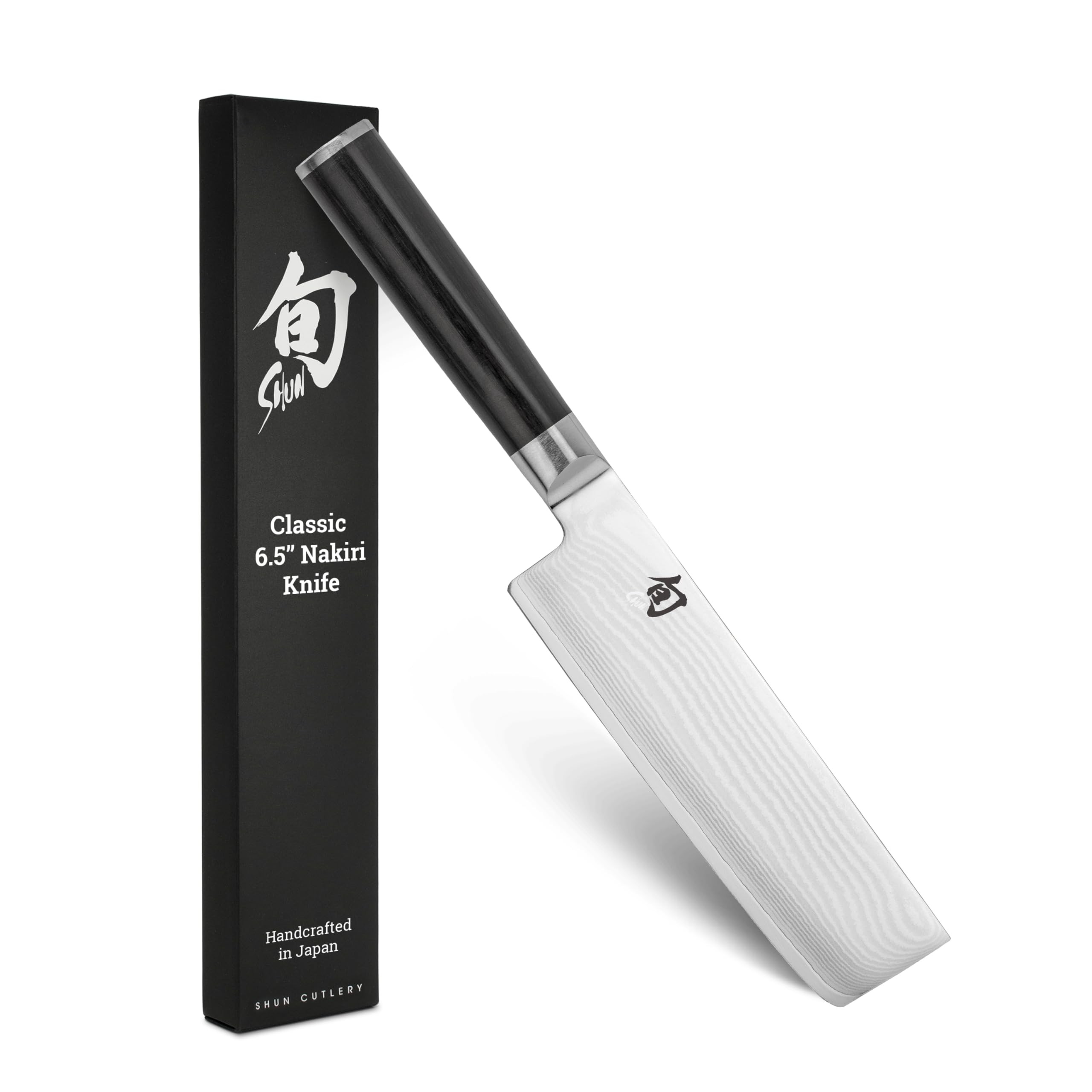
Shun Classic 6.5-Inch Nakiri
Straight cutting edge reaches the board fully on every cut , no rocking needed
Buy on AmazonMasutani VG1 Nakiri 165mm
VG-1 steel , harder and sharper than German steel, easier to maintain than SG2
Check availability at Masutani
Shun Classic 8-Inch Chef's Knife
VG-MAX steel with 68-layer Damascus cladding , razor-sharp out of the box
Buy on Amazon| Product | Price Range | Top Strength | Key Weakness | Buy |
|---|---|---|---|---|
| Shun Classic 6.5-Inch Nakiri best overall | $$$ | Straight cutting edge reaches the board fully on every cut , no rocking needed | Dedicated vegetable knife , less versatile than a chef's knife | Buy on Amazon |
| Masutani VG1 Nakiri 165mm also consider | $$ | VG-1 steel , harder and sharper than German steel, easier to maintain than SG2 | Less name recognition than Shun or Wüsthof | Check Price |
| Shun Classic 8-Inch Chef's Knife also consider | $$$ | VG-MAX steel with 68-layer Damascus cladding , razor-sharp out of the box | Hard steel (61 HRC) is more brittle , chip risk on bones or frozen food | Buy on Amazon |
| Victorinox Fibrox Pro 8-Inch Chef's Knife also consider | $ | Best-performing knife under $50 , used in professional kitchens worldwide | Stamped steel loses its edge faster than forged alternatives | Buy on Amazon |
| Yoshihiro Kurouchi Black-Forged Blue Steel Santoku Knife 6.5" also consider | $$$ | Blue | High-carbon steel requires oiling and drying after each use to prevent rust | Buy on Amazon |
The nakiri is one of the most misunderstood knives in a Western cook’s vocabulary. Not because it’s complicated, but because most people encounter it after years of using a chef’s knife for everything and can’t immediately picture what problem it solves. Here’s the short answer: if you prep a serious volume of vegetables, the nakiri’s flat edge contacts the cutting board completely on every stroke, no rocking, no uncut hinge at the tip. Carrots, cabbage, leeks, fennel , each cut lands cleanly. That’s the whole case for it.
This guide covers the best Japanese nakiri knives worth buying right now, plus a few comparison points for buyers who aren’t sure whether a nakiri is actually what they need. For a broader look at blade categories, our Knives & Sharpeners hub is the right starting point.
What to Look For in a Japanese Nakiri Knife
Steel Type
The steel spec matters more in Japanese knives than in German ones, because Japanese blades run at higher hardness levels. VG-MAX and VG-10 are the most common stainless options , both hold an edge well and can be sharpened at home with a whetstone. VG-1, used in the Masutani, is less flashy but performs reliably and sits at a hardness level that’s forgiving enough for regular home use. Blue Steel (Aogami) is a different category entirely: reactive, demanding, and exceptionally sharp when properly maintained. Choose it only if you’re prepared for the maintenance commitment.
Bevel Type
Most nakiris sold in Western markets are double-bevel, meaning sharpened on both sides. Single-bevel nakiris exist and are preferred by some purists, but they require significantly more skill to sharpen and are designed for right-handed use by default. For nearly everyone reading this, double-bevel is the correct choice.
Blade Length
The standard nakiri runs 160mm to 170mm (roughly 6.5 inches). That’s enough blade for most vegetable prep without feeling unwieldy. Longer options exist but offer limited practical advantage unless you’re breaking down large cabbages or squash regularly.
Handle Fit
Japanese handles tend to run lighter and slimmer than German equivalents. The D-shaped Pakkawood handle on Shun’s lineup fits most hands well and resists moisture. Traditional octagonal or oval wa-handles (seen on the Masutani) feel more neutral but take some adjustment if you’re coming from a Western grip. Neither is wrong. Pick up both styles if you can before buying.
Top Picks
Best Overall: Shun Classic 6.5-Inch Nakiri
The Shun Classic 6.5-Inch Nakiri is the cleanest entry point into Japanese nakiri knives for a cook who wants quality without a steep learning curve. VG-MAX steel, clad in 68 Damascus layers, comes sharp out of the box and holds that edge through serious use. The straight cutting edge does exactly what a nakiri should: it reaches the board fully on every downward cut, which means no trailing uncut piece when you’re slicing through a bunch of scallions or julienning carrots.
The D-shaped Pakkawood handle is one of the better ergonomic decisions in this price range. It orients the blade consistently in your hand without having to think about it.
Two limitations worth being direct about. First, the blunt tip means you cannot use this for scoring, piercing, or any task that needs a pointed blade. It is a dedicated vegetable knife. If you’re expecting it to sub for a chef’s knife occasionally, it won’t. Second, at premium pricing, it’s a considered purchase. Check current price on Amazon before assuming it fits your budget.
The Shun Classic is also available as an 8-inch chef’s knife if you want a matched set , more on that below.
Best Value Pick: Masutani VG1 Nakiri 165mm
The Masutani VG1 Nakiri 165mm is the knife I’d recommend to someone who knows what a nakiri does and wants one that will perform seriously without paying the Shun premium. Masutani is a small producer out of Echizen, one of Japan’s established knife-making regions, and the hand-finishing shows in the fit and feel.
VG-1 steel runs harder than German steel and sharpens to a finer edge. It’s a step below SG2 in terms of edge retention, but it’s also considerably more forgiving to sharpen at home, which matters if you’re maintaining the blade yourself on a whetstone. The nakiri geometry here is correct: flat profile, full contact on every stroke, no belly.
The honest limitation is name recognition. Masutani doesn’t have the retail presence of Shun or Wüsthof, which means if you take this to a sharpening service, some technicians won’t be familiar with VG-1 and may use the wrong angle or abrasive. If you sharpen your own knives, this is a non-issue. If you rely on a service, ask specifically whether they work with Japanese single-crystal steels.
Priced in the mid range, it costs notably less than the Shun nakiri for performance that’s competitive in the same category. For pure nakiri work, this is my actual recommendation.
For Enthusiasts: Yoshihiro Kurouchi Black-Forged Blue Steel Santoku 6.5”
The Yoshihiro Kurouchi Black-Forged Blue Steel Santoku 6.5” isn’t a nakiri, but it belongs in this guide as a serious alternative for buyers who want a Japanese blade with more versatility than a dedicated vegetable knife. The santoku’s slight tip and wider blade make it usable for proteins as well as vegetables, while still being thinner and lighter than a German chef’s knife.
Blue Steel (Aogami #2) is reactive high-carbon steel. It will rust if left wet. It needs to be dried after every use, occasionally wiped with food-safe oil, and stored away from moisture. (I realize that sounds like a lot. For the right cook, it becomes automatic in about two weeks.) The Kurouchi finish, which leaves the blade’s upper half with a blacksmith’s oxidized texture, provides some natural rust resistance and a visual character that most stainless knives don’t have.
Sharpening requires proper Japanese whetstones. This is not a knife you bring to a strip-mall sharpening service. If that’s a real constraint in your situation, the Shun or Masutani are better choices.
Premium pricing. The commitment required is real, and I’d rather say so plainly than let someone buy this as a gift only to have it rust in a drawer.
The Japanese Benchmark: Shun Classic 8-Inch Chef’s Knife
For buyers who are still deciding between a nakiri and a chef’s knife, the Shun Classic 8-Inch Chef’s Knife represents the Japanese chef’s knife standard. VG-MAX steel, 68-layer Damascus cladding, the same D-shaped Pakkawood handle as the nakiri. It is lighter and thinner than the Wüsthof Classic or the Zwilling J.A. Henckels Chef Knife, which translates to better precision on vegetables but reduced tolerance for bones, hard squash, and frozen food.
The 61 HRC hardness is the reason for both its sharpness and its fragility. Do not use it on frozen items. Do not use a honing rod on it. A ceramic rod or whetstone only.
Premium pricing, comparable to the nakiri. If you cook a mixed diet and need one knife that handles meat, fish, and vegetables, this is the more practical choice. If your prep is predominantly vegetable-focused, the nakiri is the better tool.
The Value Benchmark: Victorinox Fibrox Pro 8-Inch Chef’s Knife
The Victorinox Fibrox Pro 8-Inch Chef’s Knife is here because any honest knife guide needs a value reference point. Budget pricing, stamped blade, utilitarian handle. It is used in professional kitchens because it’s light, reasonably sharp out of the box, and can be abused without much financial consequence.
The stamped blade loses its edge faster than any forged knife in this guide. If you’re comparing it to the Masutani or the Shun, the edge retention isn’t close. But if someone tells you that you must spend premium prices to have a functional kitchen knife, the Victorinox Fibrox is the counter-argument. It works. The handle won’t inspire you, and you’ll sharpen it more often, but it performs the job.
For nakiri-specific work, the Victorinox isn’t a substitute. The flat cutting edge of a proper nakiri has no equivalent in a chef’s knife profile, regardless of price.
How to Choose
Do You Actually Need a Nakiri?
If most of your cooking involves proteins with occasional vegetable sides, a chef’s knife handles both and a nakiri adds a knife you’ll reach for less often. If you’re doing serious vegetable prep regularly, breaking down large quantities of produce for roasting, stock, or meal prep, the nakiri’s flat edge and push-cut geometry make that work faster and cleaner. The Mac Professional Series Chef’s Knife is worth considering as a pointed alternative with a similarly thin Japanese profile, if you want Japanese steel without the specialization.
Nakiri vs. Santoku
The santoku has a slight curve to the blade and a pointed tip, making it more versatile than a nakiri but less optimized for pure vegetable work. If you want a single blade that handles everything reasonably well, the santoku is the better generalist. I covered this comparison in more detail in the 5-inch santoku knife and Zwilling Henckels Santoku Knife pieces if you want a direct comparison.
Budget vs. Premium
The Masutani sits at mid-range pricing and outperforms its cost. The Shun Classic nakiri is premium and earns it, but it’s a real spend. The Victorinox has no nakiri equivalent at budget pricing, because a nakiri is by nature a more specialized tool. A budget price point gets you a competent chef’s knife. It doesn’t get you a well-made nakiri.
For more context on Japanese knives across different price points, the full knife and sharpener roundups cover the category in more depth.
Sharpening Logistics
This matters more than most buyers factor in. If you own a whetstone and use it, the Masutani VG1 and Shun Classic are both maintainable at home. If you rely on a sharpening service, confirm they work with Japanese steels before buying. If you currently use a pull-through sharpener, none of these knives should go near it.
Frequently Asked Questions
What makes a nakiri knife different from a chef’s knife?
The nakiri has a straight cutting edge with no belly or curve. A chef’s knife is designed for rocking cuts, where the tip stays on the board and the blade rocks forward. A nakiri is designed for push cuts and pull cuts straight down, which means the entire edge contacts the board on every stroke. For vegetables, that produces cleaner, more uniform cuts without a trailing piece left uncut at the tip.
Is the Shun Classic Nakiri worth the premium price?
For a cook who preps significant vegetable volume and wants a knife that will last decades with proper care, yes. VG-MAX steel holds an edge well, the fit and finish are genuinely high quality, and Shun’s warranty covers manufacturing defects. If your vegetable prep is occasional, a mid-range option like the Masutani VG1 Nakiri makes more practical sense.
Can I use a nakiri for meat?
Technically, but it’s not the right tool. The nakiri’s flat, wide blade and blunt tip make it poorly suited for proteins. It won’t break down a chicken, can’t score meat, and the blade geometry isn’t designed for the rocking or slicing motion most cooks use for meat. If you need one knife that handles both, a Japanese chef’s knife or santoku is the more practical choice.
What’s the difference between VG-1, VG-10, and VG-MAX steel?
All three are stainless Japanese steels. VG-1 is a workhorse: hard enough for a fine edge, forgiving enough for regular home sharpening. VG-10 adds cobalt for better edge retention. VG-MAX is Shun’s proprietary refinement of VG-10, with additional tungsten and cobalt. In practice, for a home cook, the differences are smaller than the marketing suggests. Sharpening technique and frequency matter more than incremental steel differences at this level.
How do I sharpen a Japanese nakiri at home?
A whetstone is the correct tool. Start with a medium grit (around 1000) to reset the edge, finish with a fine grit (3000 to 6000) to refine it. Hold the blade at the manufacturer’s specified angle, typically 15 to 16 degrees for Japanese knives. Do not use a pull-through sharpener or a honing steel on high-hardness Japanese blades. Ceramic honing rods are acceptable for light maintenance between sharpenings.
Frequently Asked Questions
What is a nakiri knife used for?
A nakiri is a Japanese vegetable knife with a flat, rectangular blade designed for push-cutting and chopping vegetables. Its straight edge contacts the cutting board fully on every stroke, which means no uncut hinge at the tip — a common issue when rocking a chef's knife through dense vegetables like carrots or cabbage.
Is a nakiri knife worth it if I already own a chef's knife?
It depends on how much vegetable prep you do. A chef's knife can handle most tasks, but the nakiri's flat edge and lighter blade make repetitive vegetable work noticeably faster and more comfortable. If vegetables are a significant part of your daily cooking, it earns its place.
What steel is best for a Japanese nakiri knife?
VG-MAX and VG-10 stainless steels offer a good balance of sharpness and corrosion resistance for most home cooks. High-carbon steels like Blue Steel hold a finer edge but require drying and oiling after each use to prevent rust. For low-maintenance performance, a stainless Japanese steel in the 60–62 HRC range is the practical choice.
What is the difference between a single-bevel and double-bevel nakiri?
A single-bevel nakiri is ground on one side only, producing an extremely acute edge favored by professional Japanese cooks. It requires more skill to maintain and is typically not recommended for beginners. A double-bevel nakiri is ground on both sides like a Western knife, making it easier to sharpen and suitable for both right- and left-handed users.
Can a nakiri knife cut meat?
A nakiri can slice boneless meat, but it is not designed for it. The thin blade is optimized for vegetable prep and is more brittle than a heavier German chef's knife. Using it on bones or frozen food risks chipping the edge. If you want one knife that does everything, a santoku or chef's knife is a better choice.
Where to Buy
Shun Classic 6.5-Inch NakiriSee Shun Classic 6.5-Inch Nakiri on Amazon