Knife Bags for Chefs: Protection Without the Bulk

Affiliate disclosure: Some links on this page are affiliate links. If you buy through them we earn a small commission at no extra cost to you. Recommendations are research-driven; we don't claim personal use of every product reviewed. Product prices and availability are accurate as of the date published and are subject to change. Always check Amazon for current pricing before purchasing. Learn more.
Quick Picks
Boldric Canvas 20-Pocket Knife Roll
20 pockets accommodate a full professional knife kit
Buy on AmazonA decent knife bag should be boring. It should hold your knives, protect the edges, travel without drama, and stay out of the way. That it’s apparently difficult to find one that does all four things explains why culinary students and serious home cooks keep asking about this category. Most bags on the market either pack like a suitcase when you only own six knives, or collapse into something that offers your blades about as much protection as a dish towel. If you’ve built up a real collection over time (and if you’ve been reading through our Knives & Sharpeners section, you probably have), the storage question eventually becomes unavoidable.
This guide focuses on what to actually look for in a knife roll or bag, gives you a real recommendation with honest caveats, and cuts through the feature lists that sound impressive until you’re standing in a parking lot trying to reroll a canvas bundle with wet hands.
What to Look For
Pocket Count and Configuration
Pocket count matters less than pocket size and spacing. A roll with twenty pockets is useless if eight of them are too narrow for a gyuto or a long slicing knife. Before you buy, measure your longest blade, because a 270mm blade needs a slot with clearance to spare, not a slot that technically fits if you angle it in at precisely the right degree.
For most home cooks with a serious collection, somewhere between twelve and twenty pockets covers the range: chef’s knife, bread knife, two or three Japanese knives, a paring knife, a boning knife, kitchen shears, honing rod, and a few extras. If you’re the kind of cook who owns a Yoshihiro Kurouchi Black-Forged Blue Steel Santoku alongside a standard German workhorse and a nakiri, you know the collection grows in ways you didn’t originally plan for.
Material
Canvas is the standard for working knife rolls. It’s durable, relatively easy to wipe down, folds without cracking in cold weather, and doesn’t add significant weight. The tradeoff is that canvas is not waterproof, which matters if you’re transporting the roll through rain or working in a kitchen where surfaces are wet. Waxed canvas addresses this partially, though most commercially available rolls skip the wax treatment.
Leather rolls are heavier and more expensive, and while they look better over time, they require more maintenance and significantly more money. Synthetic materials (mostly ballistic nylon or polyester) are lighter and often waterproof, but feel cheaper in the hand and don’t hold up to the same number of cycles.
Closure and Security
A roll that doesn’t stay closed under load is a liability. Look for reinforced ties or straps that won’t stretch out after six months of use. A bag format with zipper closure adds security but loses some of the quick-access convenience of a roll. If you’re transporting knives regularly, the closure system matters more than it does for a roll that just lives in a drawer.
Portability
Shoulder straps are not a luxury if you’re carrying a fully loaded knife roll along with other gear. A roll that weighs two pounds empty will weigh considerably more with sixteen knives in it. A strap that distributes that weight across your shoulder instead of your forearm hand-carry is a practical upgrade, not a premium feature.
Top Picks
Boldric Canvas 20-Pocket Knife Roll: The Real Recommendation
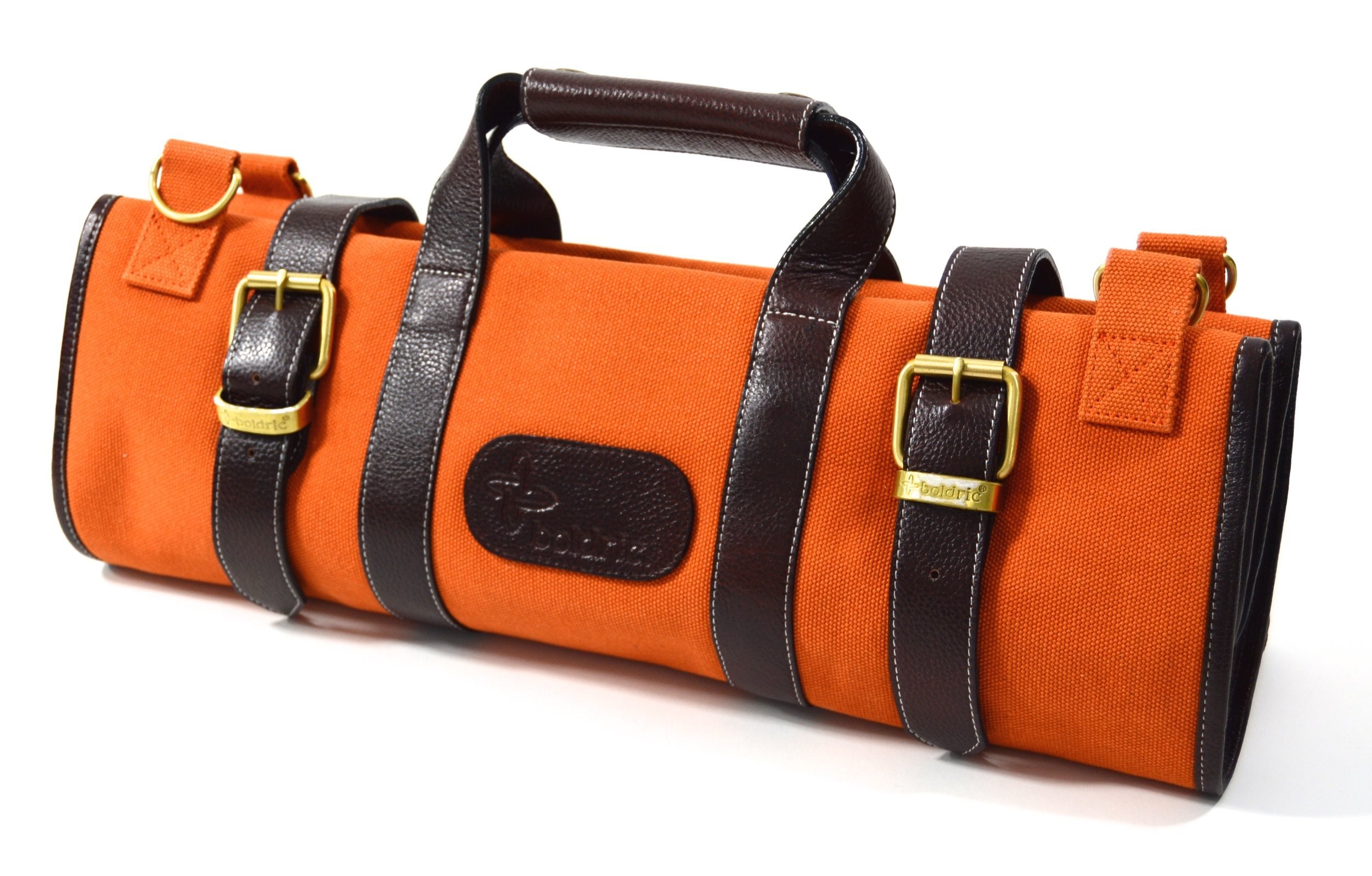
If you want a direct answer, it’s the Boldric Canvas 20-Pocket Knife Roll. It’s mid-range pricing, it works, and it doesn’t ask you to compromise much.
See the Boldric 20-Pocket Knife Roll on Amazon
Twenty pockets sounds like more than you need until you actually fill it. The configuration runs a mix of narrow slots for paring and utility knives and wider slots that accommodate a long chef’s knife or a full-size bread knife without forcing. The canvas exterior is the working kind, not decorative canvas, and it cleans up with a damp cloth for most kitchen debris. Rolled compact, it fits under a bag or in an overhead compartment without ceremony. The included shoulder strap is adjustable and functions as a real carrying option when the roll is fully loaded.
That’s the case for it. Now the honest caveats.
Fully loaded, this roll is large. If you’re working from a smaller home kitchen with limited storage, a twenty-pocket roll at capacity is awkward to store horizontally in a drawer and takes up real counter or cabinet space when standing. It’s sized for professional transport, not apartment living. If your knife collection is six blades and you mostly cook at home, this is more roll than you need. (I use mine primarily to consolidate what would otherwise be scattered across two drawers, but I recognize that’s not a problem everyone has.)
Canvas is also not waterproof. This is a straightforward limitation, not a design flaw, but worth stating plainly. If you’re transporting this roll in rain, put it inside a bag. If spills are a regular hazard in your transport situation, consider a synthetic option or accept that you’ll occasionally need to air-dry the roll before rerolling it.
For culinary students moving between school and work, or home cooks who have accumulated a serious collection over years of buying quality Japanese knives and German workhorses, this roll accommodates the reality of that collection without requiring you to leave half of it behind. The price point is reasonable for what you get, and the construction quality is consistent with rolls that cost meaningfully more.
Check current price for the Boldric Canvas Knife Roll
Other Options Worth Knowing About
The Boldric is my recommendation, but a few other names come up often enough to address.
The Messermeister 12-Pocket Knife Roll is a legitimate alternative for cooks with smaller collections. It’s canvas, well-made, and a more compact form factor. It costs less than the Boldric and does fewer things.
The Victorinox Fibrox Knife Roll targets the budget end of the category. It works. The material quality and pocket configuration are both noticeably below mid-range, and it shows after heavy use. If budget is the constraint, it’s a functional option, but the Boldric is worth the additional investment.
For cooks who prefer a bag format over a roll, the Wusthof 9-Pocket Knife Case is a zipped hard-shell option that offers more protection in transit. It’s one of the pricier options in this class, and it’s less flexible in terms of capacity and pocket configuration.
How to Choose
If You Have a Small Collection
A roll with twelve pockets or fewer makes practical sense if you own fewer than eight knives. The Messermeister 12-Pocket or a comparable mid-range roll stores without bulk and doesn’t require you to plan your packing. The Boldric’s twenty pockets will be half-empty, which is functional but awkward.
If You’re a Culinary Student or Work in Professional Kitchens
Get the capacity now. You’ll fill it. The Boldric Canvas 20-Pocket Knife Roll and its shoulder strap are genuinely useful for the movement pattern of culinary school or a working kitchen, where you’re carrying the full kit between stations, locations, and at the end of a shift. A budget roll will not survive the cycle count.
If You Mostly Cook at Home
The question to answer honestly is whether you’re buying this for transport or for storage. If it never leaves your kitchen, a knife roll is just a storage solution, and a knife block or magnetic strip may serve you better. If you’ve been reading up on the Global G2 Chef Knife and similar quality pieces and are building a collection that deserves real protection, a roll stores edges safely in a way a block can’t always match.
If you own Japanese knives specifically, a roll with individual pockets is preferable to any storage solution where blades contact each other. Edge retention on a Masutani VG1 Nakiri 165mm or comparable thin-ground Japanese blade is not something to risk against a drawer full of loosely stored knives. The Boldric Canvas 20-Pocket Knife Roll stores edges safely in a way a block can’t always match.
Budget Considerations
Mid-range is the right tier for most buyers in this category. Budget rolls compromise on material and construction in ways that show up within a year of regular use. Premium rolls add weight, cost, and often aesthetic considerations that don’t translate to meaningfully better knife protection. Check current pricing for the Boldric Canvas 20-Pocket Knife Roll on Amazon before buying, since pricing shifts regularly.
The broader context for your buying decisions, including everything from knife selection to sharpening equipment, is covered in our Knives & Sharpeners section if you want to work through the full picture.
Frequently Asked Questions
How many pockets does a knife roll need?
For most home cooks, twelve to sixteen pockets is sufficient. If you’re a culinary student, working cook, or have accumulated a substantial collection of chef’s, Japanese, and specialty knives, twenty pockets gives you room for the full kit without forcing you to edit before every trip. Count your current knives, add four for what you’ll likely acquire in the next two years, and size from there.
Is canvas or leather better for a knife roll?
Canvas is the practical choice for most buyers. It’s lighter, more affordable, easier to clean, and holds up to regular transport. Leather develops character over time and feels more substantial in the hand, but it’s heavier, more expensive, and requires care. Neither is objectively wrong. Canvas wins on the working kitchen criteria.
Can I carry a knife roll on an airplane?
Not in carry-on. Knives in any configuration must be checked. The Boldric rolls compact enough to fit inside a checked bag without occupying excessive space. Wrap the roll in clothing for additional protection if the bag is being handled roughly. This is a straightforward TSA rule with no airline-by-airline variation worth strategizing around.
How do I clean a canvas knife roll?
Wipe down with a damp cloth for surface debris and most kitchen residue. For heavier soiling, a mild soap solution and a scrub brush followed by air-drying works well. Do not machine-wash canvas knife rolls. The structure degrades and the roll may lose its shape. Air-dry completely before rerolling with knives inside.
What’s the difference between a knife roll and a knife bag?
A knife roll stores blades in individual pockets on a flat panel, which then rolls up and ties closed. A knife bag uses a structured bag format, often with zipper closure, and may include additional storage for tools, steels, and accessories. Rolls are more compact and lighter. Bags offer more protection in rough handling and can carry more non-knife items. Professional cooks tend to use rolls. The right format depends on how you’re transporting and what else you’re carrying alongside the knives.
Frequently Asked Questions
What is the difference between a knife roll and a knife bag?
A knife roll is a flexible cloth or leather wrap that folds around individual knife pockets and ties closed, designed to be compact and rolled for transport. A knife bag has a fixed structure with zipper closure, more like a tool bag. Rolls are lighter and more packable; bags offer more protection and are easier to access quickly without unrolling.
How many slots do I need in a chef knife bag?
For a working home cook or culinary student, 12 to 20 pockets typically covers a full kit: chef's knife, bread knife, two or three Japanese knives, a paring knife, boning knife, kitchen shears, honing rod, and extras. Measure your longest blade before buying — a 270mm gyuto or slicing knife needs a slot with clearance, not a tight fit.
What material is best for a chef knife bag?
Canvas is the practical standard. It is durable, lightweight, easy to wipe clean, and does not crack in cold weather. Leather looks better over time but costs more and requires maintenance. Synthetic materials like ballistic nylon are lighter and often waterproof but feel less durable in the hand. For most users who transport knives regularly, waxed or heavy canvas is the right balance of function and longevity.
Do knife rolls protect blade edges during transport?
A well-made roll with individual pocket slots protects edges adequately for transport in a bag or backpack. Pockets prevent blades from contacting each other. However, a roll does not provide the same level of edge protection as individual blade guards or sheaths. For fragile Japanese blades, adding individual edge guards inside the roll pockets adds meaningful protection.
Can I carry a knife roll or bag on an airplane?
Knives must be checked in luggage on commercial flights — they are not permitted in carry-on bags regardless of how they are stored. A knife roll or bag packed securely in checked luggage is an acceptable way to travel with a knife kit. Confirm current TSA rules before traveling, as regulations can change.
Where to Buy
Boldric Canvas 20-Pocket Knife RollSee Boldric Canvas 20-Pocket Knife Roll on Amazon