Yoshihiro Kurouchi Santoku: 5 Black-Forged Knives Reviewed

Affiliate disclosure: Some links on this page are affiliate links. If you buy through them we earn a small commission at no extra cost to you. Recommendations are research-driven; we don't claim personal use of every product reviewed. Product prices and availability are accurate as of the date published and are subject to change. Always check Amazon for current pricing before purchasing. Learn more.
Quick Picks
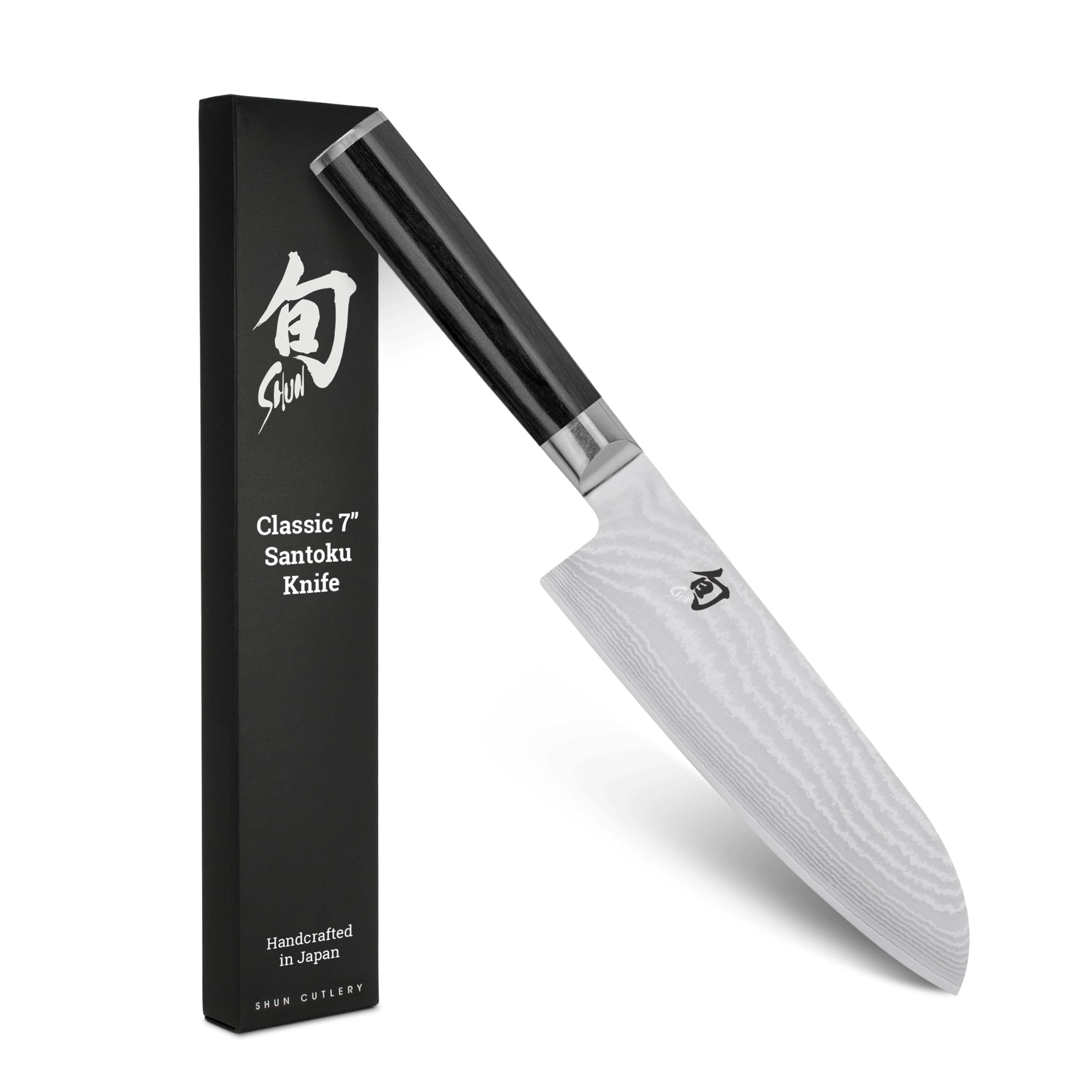
Shun Classic 7-Inch Santoku
VG-MAX Damascus steel , same exceptional sharpness as the chef's knife
Buy on Amazon
Wüsthof Classic 7-Inch Santoku
German steel in a Japanese blade shape , great of the best of both traditions
Buy on Amazon| Product | Price Range | Top Strength | Key Weakness | Buy |
|---|---|---|---|---|
| Yoshihiro Kurouchi Black-Forged Blue Steel Santoku Knife 6.5" best overall | $$$ | Blue | High-carbon steel requires oiling and drying after each use to prevent rust | Buy on Amazon |
| Shun Classic 7-Inch Santoku also consider | $$$ | VG-MAX Damascus steel , same exceptional sharpness as the chef's knife | Hollow-ground edge requires whetstone maintenance , not for casual sharpeners | Buy on Amazon |
| Wüsthof Classic 7-Inch Santoku also consider | $$$ | German steel in a Japanese blade shape , great of the best of both traditions | German steel is softer than Japanese , needs more frequent honing | Buy on Amazon |
| MAC Professional 8-Inch Chef's Knife also consider | $$ | Thin Japanese blade profile with a Western-style handle , best of both | Less name recognition than Shun or Wüsthof , harder to buy as a gift | Buy on Amazon |
| Victorinox Fibrox Pro 8-Inch Chef's Knife also consider | $ | Best-performing knife under $50 , used in professional kitchens worldwide | Stamped steel loses its edge faster than forged alternatives | Buy on Amazon |
The santoku is not a knife most people seek out first. You buy a chef’s knife, use it for years, and eventually notice there’s a category of prep work where the shorter, flatter profile would actually serve you better. Thinly sliced vegetables, fish fillets, herbs. The rocking motion of a Western chef’s knife starts to feel like the wrong tool. If that’s where you are, this guide covers the five knives worth your attention, from a traditional Japanese black-forged blade that demands real commitment to a budget workhorse that belongs in every honest conversation about value. Before we get into individual picks, the broader context on blade types, steel hardness, and what separates Japanese from German construction lives in the Knives & Sharpeners hub if you want it.
One thing worth stating upfront. Three of these are santokus and two are chef’s knives. I included the chef’s knives because some buyers searching “santoku” are actually trying to answer a simpler question: which knife should I buy for general prep? The MAC and Victorinox answer that question better than some of the dedicated santokus in this price range. I’ll flag where each is strongest.
What to Look For
Steel Type and Hardness
Japanese and German knives are not competing for the same use case. Japanese steel runs harder, holds a finer edge longer, and is more brittle. German steel is softer, takes a broader bevel, and tolerates abuse that would chip a Japanese blade. For santoku work specifically, the harder Japanese steel tends to reward you because the cuts are clean and repetitive rather than heavy. But “reward” only applies if you’re willing to maintain it properly.
The relevant scale is Rockwell hardness (HRC). German steel like the Wüsthof Classic runs around 58 HRC. The Shun Classic uses VG-MAX steel at 61 HRC. The Yoshihiro Kurouchi uses Blue Steel (Aogami), which can reach 62-64 HRC. Each step up in hardness means a sharper, more durable edge and a more demanding sharpening protocol.
Blade Profile and Geometry
Santoku blades are shorter (typically 6.5 to 7 inches), have a flatter edge profile, and lack the pronounced tip of a Western chef’s knife. That flat profile makes push-cutting more natural and rocking less so. If your prep style relies on a rocking motion, a chef’s knife will suit you better. If you primarily push-cut through vegetables or slice fish, the santoku geometry pays off.
Handle Fit and Weight
Weight matters over a long prep session more than it does for a five-minute task. The Yoshihiro uses a traditional Japanese octagonal handle, which is lighter and positions your grip closer to the blade. Western handles sit heavier and farther back. Neither is objectively correct, but if you have smaller hands or prep for thirty-plus minutes at a stretch, the lighter handle will make a difference you’ll notice. (I say this having switched from a heavier setup and been mildly annoyed at how obvious the improvement was.)
Hollow Edge (Granton Scallops)
Both the Shun Classic and Wüsthof Classic santokus have hollow-ground edges. The air pockets created by those scallops reduce adhesion when slicing soft foods. Cucumber, zucchini, raw fish. If food sticking to your blade is a daily frustration, this is one of the few features that actually addresses it directly rather than just sounding useful.
Top Picks
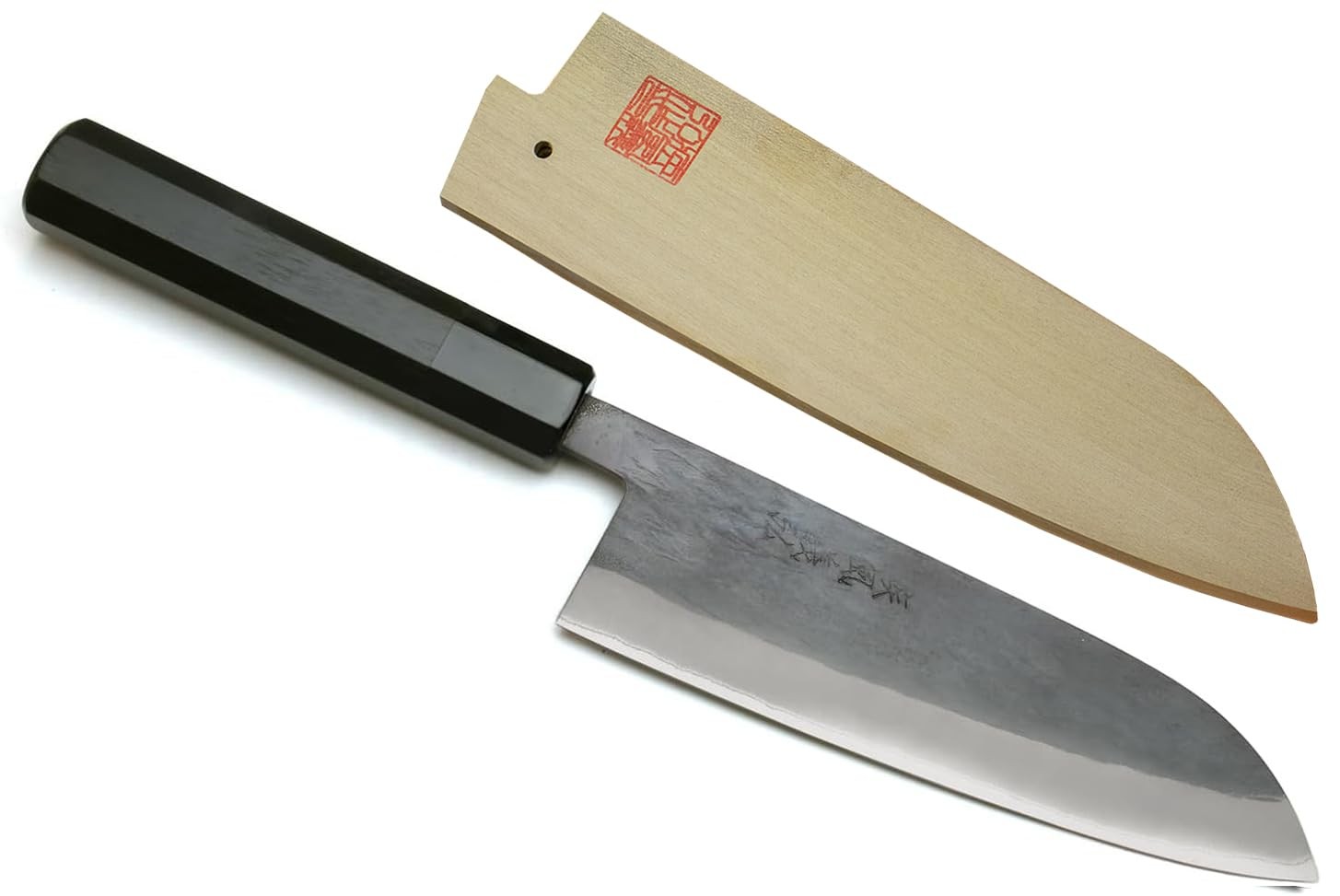
Yoshihiro Kurouchi Black-Forged Blue Steel Santoku 6.5”
The Yoshihiro Kurouchi Black-Forged Blue Steel Santoku is a working knife with a specific audience: people who want traditional Japanese craftsmanship and are prepared to earn it.
Blue Steel (Aogami No. 2) is a high-carbon alloy that holds an exceptional edge but reacts with water and acidic foods. The kurouchi finish on the spine and upper blade provides some rust resistance by leaving the blacksmith’s oxidized layer intact rather than polishing it away. It looks like what it is. A hand-forged knife. Not pretty in a jewelry-box way. Functional in a way that makes you take it more seriously.
The maintenance commitment here is not optional. After every use: wipe dry, apply a light coat of camellia oil or food-safe mineral oil, store properly. If you cut citrus and leave the knife wet for twenty minutes, you’ll find a rust spot. If that sentence causes you any anxiety, this is not your knife. If it sounds completely manageable because that’s already how you treat your cast iron, you’ll be fine.
Sharpening requires proper Japanese whetstones. A pull-through sharpener will ruin the geometry. Budget for a 1000/6000 combination stone minimum. Check current price on Amazon. It’s at the premium end of this roundup, and that price only makes sense if the maintenance approach matches your actual habits rather than your aspirational ones.
Shun Classic 7-Inch Santoku
The Shun Classic 7-Inch Santoku is the most practical premium Japanese santoku for buyers who want Japanese steel performance without the reactive-core maintenance overhead.
VG-MAX steel at 61 HRC holds an exceptional edge. The Damascus cladding (34 layers each side) is functional as well as visual. It protects the harder core, slightly improves corrosion resistance, and reduces the “sticky” feeling some knives develop with heavy use. The hollow-ground edge addresses food adhesion directly.
The handle is a D-shaped PakkaWood, which suits right-handed grip naturally. Left-handed cooks should look at the Shun Classic Left-Handed version specifically.
Two honest limitations. At 61 HRC, this blade will chip if you use it on hard winter squash, bones, or anything frozen. That’s not a flaw, it’s the physics of harder steel. Treat it like a precision instrument rather than a workhorse and it will stay sharp for years with proper whetstone maintenance. A honing steel is not sufficient for this blade. Comparable to the Wüsthof Classic santoku in price category, but running three HRC points harder with a finer bevel, which means better edge retention and more demanding sharpening requirements.
Wüsthof Classic 7-Inch Santoku
The Wüsthof Classic 7-Inch Santoku is for buyers who want the santoku profile without committing to Japanese sharpening protocol.
German X50CrMoV15 steel at 58 HRC is forgiving in a way the Shun and Yoshihiro are not. You can hone it on a standard honing rod between sharpenings. It tolerates occasional harder-than-ideal cuts without chipping. The Granton (hollow) edge reduces drag and food adhesion comparably to the Shun’s hollow grind.
The full-tang construction and triple-riveted handle are the same specification as the Wüsthof Classic chef’s knife, which I cooked with for years before switching to a lighter setup. The quality of fit and finish is reliable. The blade geometry is genuinely a santoku profile rather than a chef’s knife rebranded. Wüsthof got this right.
The trade-off is real though. Softer steel means more frequent honing. This knife will need a honing rod every two or three heavy prep sessions. If you already hone regularly, the German steel model is actually the lower-friction ownership experience. If you resist maintaining knives, both this and the Shun will eventually disappoint you, just for different reasons.
MAC Professional 8-Inch Chef’s Knife
The MAC Professional 8-Inch Chef’s Knife is not a santoku, but it answers the question most santoku shoppers are actually asking.
At mid-range pricing, the MAC Mighty (as it’s commonly known) hits a performance-to-cost ratio that consistently embarrasses more expensive knives. The blade is thin enough to perform like a Japanese knife on vegetables and fish. The steel (around 59-60 HRC) is hard enough to hold an edge longer than German alternatives but forgiving enough to sharpen on a standard whetstone without special technique. It weighs 5.8 oz.
If you’ve been searching santoku reviews because you find your current chef’s knife fatiguing over long prep sessions, the MAC solves that problem more directly than switching knife shapes. If you’re committed to the santoku profile specifically, the Shun or Wüsthof will serve you better. But for anyone doing an honest evaluation of what they actually need, this knife deserves to be in the conversation. Professional kitchens use it. That’s not incidental.
Victorinox Fibrox Pro 8-Inch Chef’s Knife
The Victorinox Fibrox Pro 8-Inch Chef’s Knife is the value benchmark in this category, and I include it because any honest guide to kitchen knives has to acknowledge it exists.
It’s a stamped blade. The edge won’t hold as long as the forged options above. The Fibrox handle is functional and slightly utilitarian. None of that changes the fact that this is a sharp, lightweight, well-balanced knife in the budget price band that professional kitchens around the world use for actual work.
If your budget is limited, this is your starting point, not a compromise. Buy it, learn to maintain it, and spend the money you saved on a decent whetstone. Your cooking will improve, and you’ll eventually understand what you actually want from a more expensive knife when you’re ready for one. That’s a better path than buying a premium knife before you’ve developed the habits to care for it.
How to Choose
If you want a dedicated traditional Japanese santoku and you’re prepared to maintain high-carbon steel: the Yoshihiro Kurouchi is the serious enthusiast’s choice. Read the maintenance section above as a checklist, not as a warning.
If you want the best Japanese santoku for everyday premium use without reactive-core concerns: the Shun Classic is the pick. It’s in the same premium tier as the Yoshihiro but significantly more practical for most kitchens.
If you want a santoku that fits into a German-steel maintenance routine you already have: the Wüsthof Classic is the right call. It doesn’t perform identically to the Shun on edge retention, but it tolerates the kind of ownership most people actually provide.
If you’re trying to solve the problem of a heavy, fatiguing knife and aren’t committed to the santoku profile specifically: the MAC Professional is probably what you need, and it costs considerably less than the premium Japanese options.
If budget is the primary constraint: the Victorinox Fibrox Pro is the honest answer. Full stop.
For buyers still working through the broader question of which blade profile suits their prep style, the Nakiri vs Santoku comparison on this site covers that ground directly. If you’re looking at higher-end Japanese single-bevel options, the Shiro Kamo Nakiri review covers similar steel and finishing considerations to the Yoshihiro. And if you’re comparing Japanese-style chef’s knives in this weight class, the Global G2 is the other knife worth benchmarking against the MAC.
The full category overview, including sharpening tools and storage, is covered in the knife and sharpener guide.
Frequently Asked Questions
What is the difference between a santoku and a chef’s knife?
A santoku is shorter (typically 6.5 to 7 inches versus 8 to 10 for most chef’s knives), has a flatter edge profile, and ends in a sheep’s-foot tip rather than a pointed tip. The flat profile favors push-cutting over rocking. For vegetable prep and fish, many cooks find the santoku more efficient. For breaking down large proteins or working with a full rocking motion, the chef’s knife is better suited.
Is Blue Steel (Aogami) worth the extra maintenance?
For the right cook, yes. Blue Steel holds a finer, sharper edge than most stainless and alloy steels in this category, and the edge quality is noticeable. The cost is real though: reactive steel requires drying and oiling after every use, proper whetstone sharpening, and attention that stainless steel simply doesn’t demand. If you already maintain cast iron and carbon steel pans as a matter of habit, Blue Steel will fit your existing routine. If you’re starting from scratch, begin with the Shun or Wüsthof and build the habits before adding reactive steel to your kitchen.
Can I sharpen a Japanese santoku with a honing rod?
A honing rod is not a sharpener. It realigns a bent edge, which works on softer German steel (around 58 HRC) but has limited effect on harder Japanese blades at 61+ HRC. The Shun Classic and Yoshihiro Kurouchi both require whetstones. For the Shun, a 1000-grit stone for sharpening and a 6000-grit stone for finishing is a reasonable minimum setup. For the Yoshihiro, stay with Japanese natural or synthetic water stones. Pull-through sharpeners are not appropriate for either blade.
How do I prevent a high-carbon steel knife from rusting?
Three steps: wipe the blade dry immediately after use (don’t leave it wet on the counter), apply a thin coat of food-safe oil (camellia oil is traditional, food-grade mineral oil works), and store it on a magnetic strip or in a knife block rather than loose in a drawer. Acidic foods like citrus, tomatoes, and onions accelerate oxidation, so pay particular attention after cutting them. A small rust spot from neglect can usually be removed with a rust eraser, but prevention is considerably easier than remediation.
Is the Victorinox Fibrox Pro good enough for serious home cooking?
Yes. The stamped blade loses its edge faster than forged alternatives, and you’ll be sharpening it more frequently over time. But out of the box it is sharp, well-balanced, and light enough for extended prep. Many professional kitchens use it. If “serious home cooking” means you need a knife that holds its edge for two months of daily use without sharpening, the forged options above will serve you better. If it means you cook real food with real attention and you’re willing to maintain your tools, the Victorinox is entirely adequate and costs a fraction of the premium tier.
Frequently Asked Questions
What is Kurouchi finish and why does it matter on the Yoshihiro santoku?
Kurouchi (blacksmith finish) is the dark iron oxide layer left on the blade from forging. It adds a degree of rust resistance to the high-carbon steel and gives the knife a traditional Japanese aesthetic. Over time it naturally wears away at the edge from use and sharpening.
What is Blue Steel (Aogami) and how hard is the Yoshihiro Kurouchi blade?
Blue Steel, or Aogami, is a high-carbon Japanese tool steel known for holding an extremely sharp edge. The Yoshihiro Kurouchi can reach 62–64 HRC on the Rockwell scale, significantly harder than German stainless knives (58 HRC) or even Shun's VG-MAX (61 HRC).
Does the Yoshihiro Kurouchi santoku require special maintenance?
Yes. Because it uses high-carbon steel rather than stainless, it will rust if not dried and lightly oiled after each use. It also requires whetstone sharpening — a honing rod won't work properly on steel this hard. It's a knife for committed cooks who enjoy proper care routines.
Is the Yoshihiro Kurouchi santoku better than a Shun or Wüsthof santoku?
It depends on priorities. The Yoshihiro offers harder steel and a more traditional Japanese blade feel, but demands more care. Shun's VG-MAX is nearly as sharp and more rust-resistant. Wüsthof's German steel is the most forgiving to maintain. The Yoshihiro is best for cooks who want peak edge performance and are comfortable with carbon steel upkeep.
What size is the Yoshihiro Kurouchi santoku and who is it best suited for?
The Yoshihiro Kurouchi santoku is typically available in a 7-inch length. It suits experienced home cooks and enthusiasts who do a lot of vegetable and fish prep, prefer a lightweight and nimble blade, and are willing to invest time in proper carbon-steel maintenance.
Where to Buy
Yoshihiro Kurouchi Black-Forged Blue Steel Santoku Knife 6.5"See Yoshihiro Kurouchi Black-Forged Blue … on Amazon